Research
Optical Wireless Communication
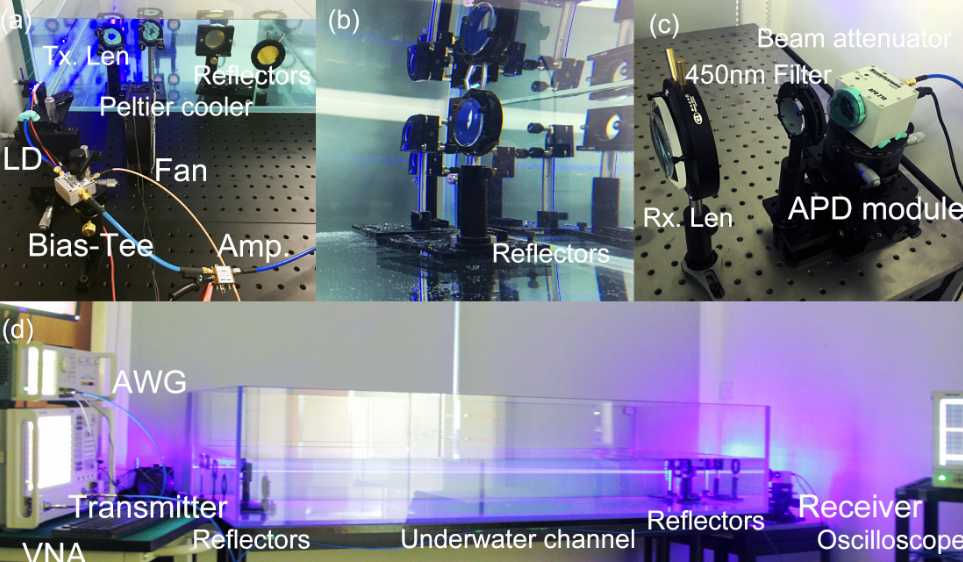
Optical Wireless Communication (OWC) is a short-range wireless access technology and an important supplement to other existing wireless communication systems. Due to the high frequency of light waves, OWC has large information carrying capacity. Light waves also have rich broadband spectrum resources and strong anti-electromagnetic interference capabilities compared with radio frequency. Recently, OWC based on high-bandwidth semiconductor light sources such as lasers and light emitting diodes (LEDs) receives extensive concern. With the development of optoelectronic materials and devices, visible light communication (VLC) will not only break the capacity bottleneck up to Gbps, but also provide indoor illumination and positioning service in the future, which plays a vital role connecting the internet of things (IoT).
Silicon Photonics
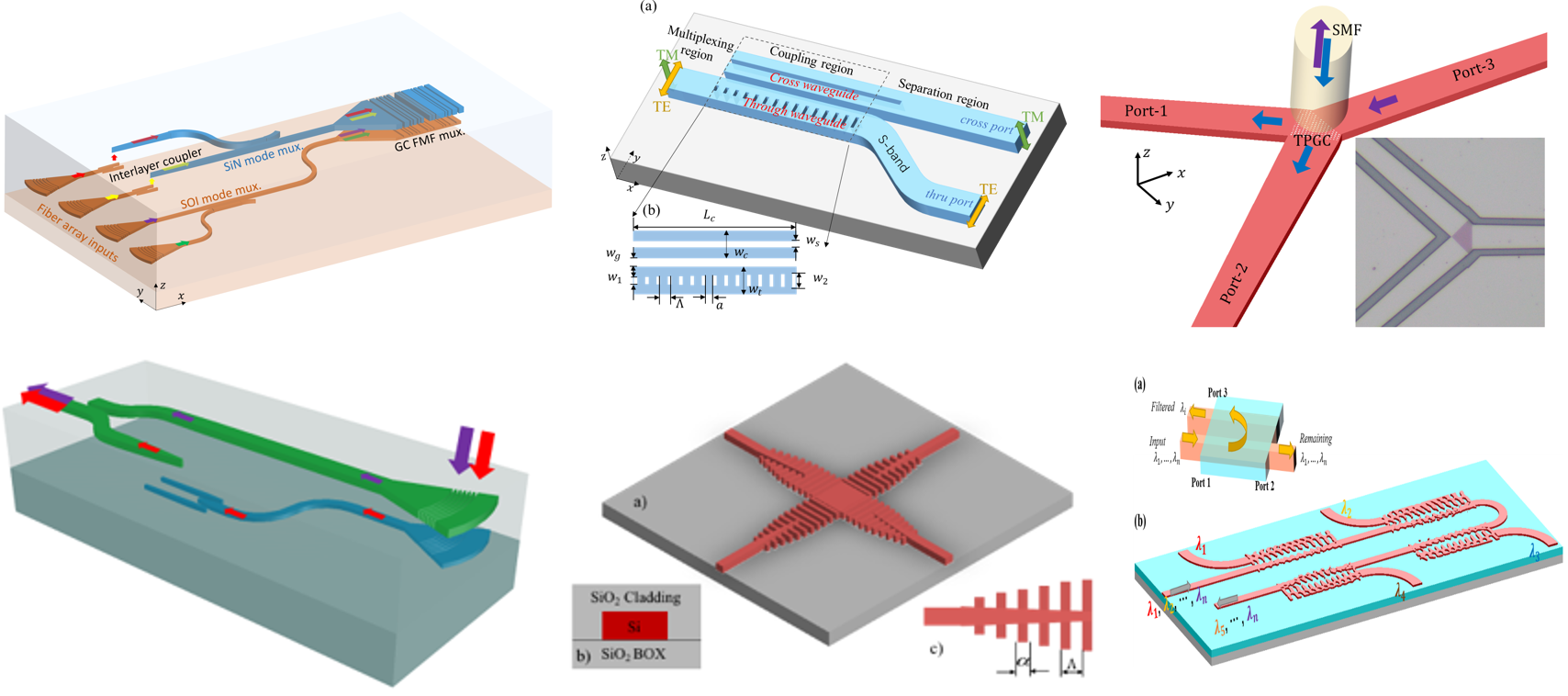
Silicon photonics is a promising solution to provide low-cost and high-performance integrated chip-based photonic devices and systems. Currently, it is commercially driven by the increasing demand for low-cost short-range optical interconnects in data centers and the computing industry. In the future, it might also be attractive for applications in biosensing and light detection and ranging (LiDAR). Our group focus on design of key passive integrated components including fiber-to-chip interface, waveguide crossings and multiplexing components (polarization, mode and wavelength division multiplexing). Apart from traditional design method based on intuition and physics, we also explore computer-automated design using advanced algorithms and deep neural networks.
LiDAR (Light Detection and Ranging)
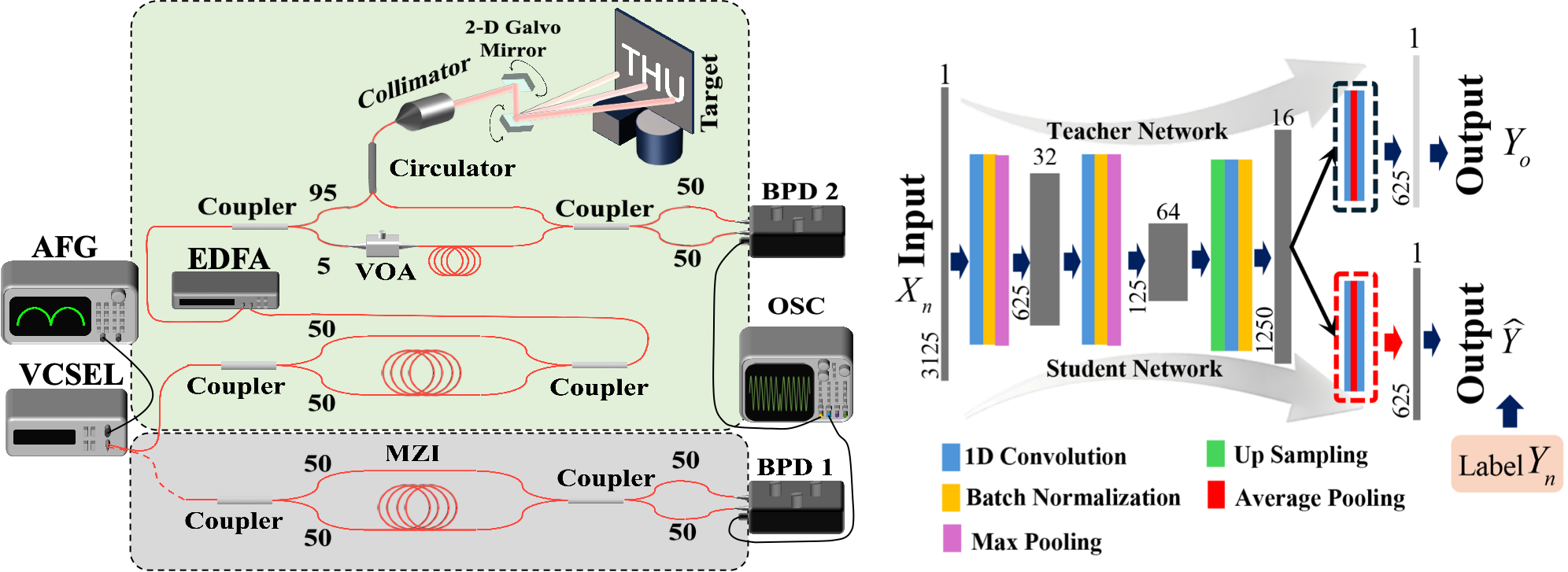
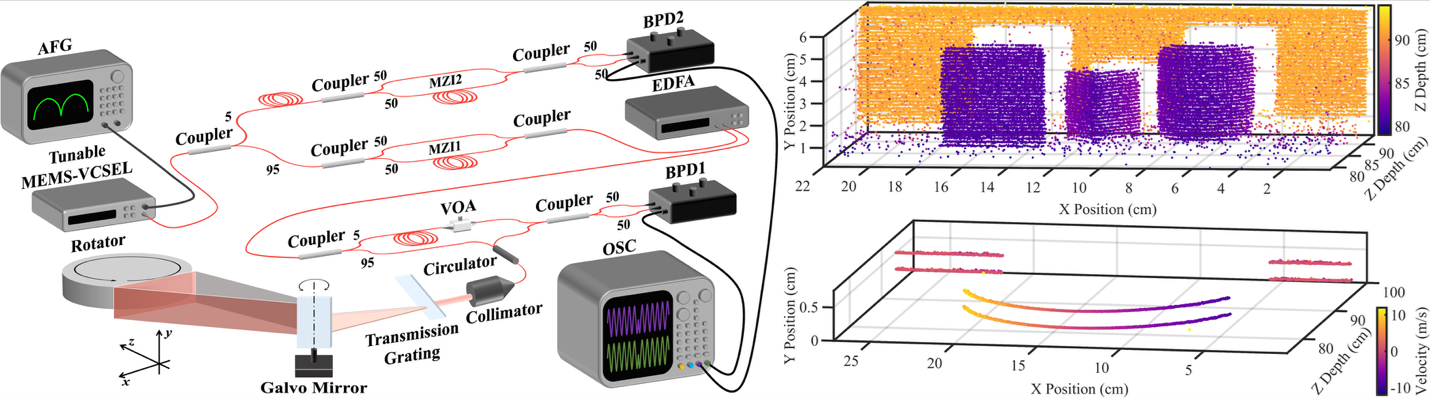
4D FMCW LiDAR and AI-Driven Laser Frequency Sweep Nonlinearity Correction: Frequency-modulated continuous-wave (FMCW) LiDAR offers significant advantages over traditional time-of-flight systems by simultaneously measuring distance and velocity to generate 4D point clouds with enhanced sensitivity. Our research focuses on developing scalable, data-efficient, and real-time 4D imaging systems. By integrating tunable cost-effective MEMS-VCSELs with novel dual Mach-Zehnder interferometer (MZI) architectures, we successfully overcome the detector bandwidth bottlenecks associated with ultra-high beat frequencies. Furthermore, we deploy lightweight, model-free fully convolutional neural networks (1-D FCN) to effectively correct laser frequency sweep nonlinearity, significantly boosting ranging precision and enabling high-frame-rate dynamic sensing for robotics and autonomous driving.
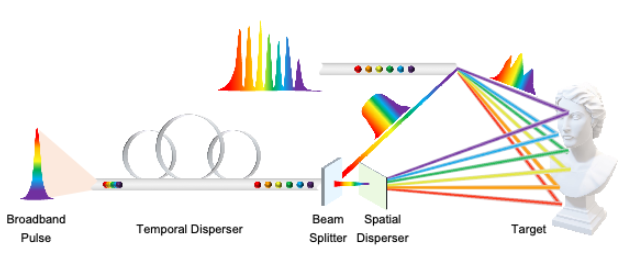
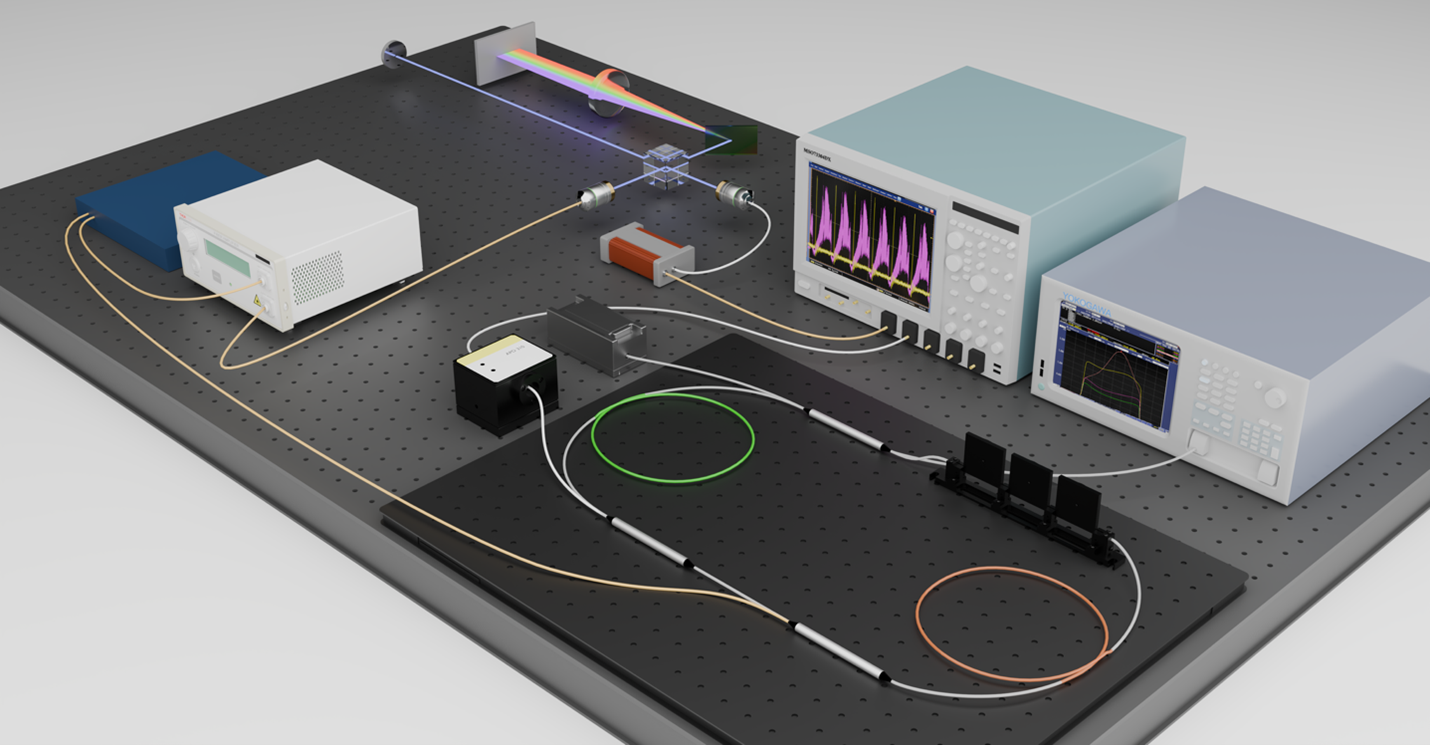
Ultrafast Quantitative Phase Imaging (QPI) LiDAR: Pushing the boundaries of scanning speed and breaking the spatial resolution limits, we combine QPI with inertia-free spectral scanning and time-stretching technologies. Driven by custom-built dissipative soliton mode-locked fiber lasers and time-stretcher, our QPI LiDAR system achieves a continuous space-wavelength-time mapping. By extracting precise quantitative phase change and frequency distribution, we achieve ultrafast line-scan rate (e.g., >30 MHz), micrometer-level lateral resolution and nanometer-level axial resolution. This enables high-throughput, high-definition 3D inspection of complex industrial and biological surfaces.
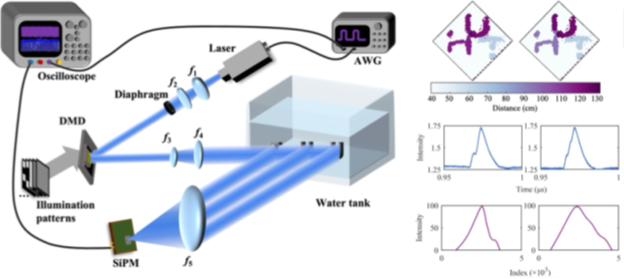
Underwater Computational Ghost Imaging (UCGI) LiDAR: High-resolution imaging and ranging in underwater environments are notoriously challenging due to severe light scattering and attenuation. To address this, we develop advanced computational ghost imaging LiDAR systems tailored for highly turbid water. By innovating spatial modulation strategies—such as our wavelet transform-based Hadamard (WTH) ordering—we prioritize critical scene structures to achieve robust multi-target detection at super-low sampling ratios (e.g., 10%). This scene-statistic-aware approach ensures high-fidelity image reconstruction and precise distance localization, offering a practical solution for high-speed marine exploration and rescue operations.
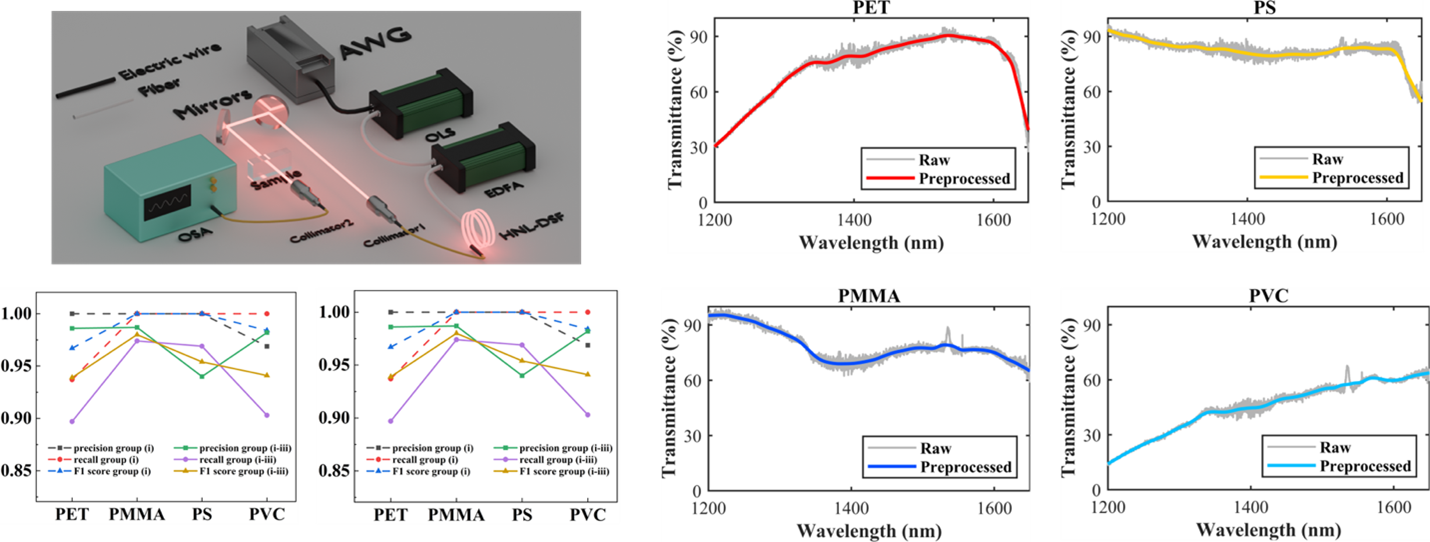
Hyperspectral Sensing and Intelligent Material Classification: Rapid and accurate material identification is critical for practical applications such as waste recycling and industrial quality control. We develop near-infrared multi-material classification systems utilizing ultra-broadband light sources generated via supercontinuum in highly nonlinear dispersion-shifted fibers (HNL-DSF). By coupling these rich hyperspectral transmittance features with advanced deep learning frameworks (1D-CNNs), our system can efficiently deconvolute overlapping spectral signals, achieving highly accurate and robust classification even for complex, multi-layered plastic objects.